Mizuki Ando
Blind Willow, Sleeping WomanMizuki Ando is a woman who can remember nearly everything except her own name when someone unexpectedly asks for it. Her episodic blank turns an ordinary question into a breach in self-recognition, and the name tag taken from her eventually brings her face to face with a truth she has long tried not to acknowledge. Her resolution is not to explain the lapse away, but to live with what has been revealed and reclaim her name as her own.
Identity and the memory lapse
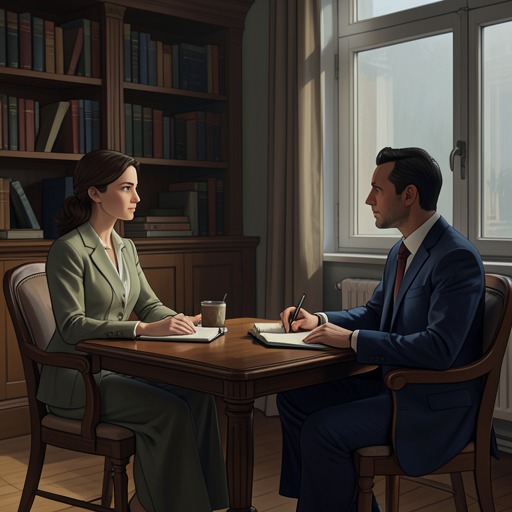
Mizuki’s married name is Mizuki Ando; her maiden name is Ozawa. The names themselves are unremarkable, but their ordinariness does not explain why one might disappear from her mind. The failure occurs chiefly when another person asks without warning: a boutique clerk requesting her name while altering a dress, or someone on the telephone asking who is speaking. In those moments, Mizuki cannot produce the answer and must search her purse for her driver’s license. On the phone, the silence while she rummages leaves the person at the other end wondering what has happened.
The lapse is sharply limited. Mizuki can remember other people’s names, her address, phone number, birthday, and passport number, as well as the numbers of friends and important clients. She has a decent memory in general; it is her own name that escapes. If she anticipates the question, or brings up her name herself, she has no difficulty. But being hurried or caught off guard seems to shut down recall, and struggling to retrieve the name only deepens the blank. What began about a year earlier as an occasional occurrence has become increasingly frequent.
By the time Mizuki describes the problem, it happens at least once a week. Without her purse and the license inside it, she fears she would have no way to identify herself in the moment. She knows that forgetting her name does not erase her existence: she still remembers her address and number, and the lapse is not the total amnesia of a film. Even so, she imagines life without a name as a dream from which one never wakes. The name is not the whole person, but its sudden absence makes her feel temporarily reduced to nobody.
Marriage and concealment
Mizuki became Mizuki Ando in the spring three years before the account of her lapses. At first the married name looked and sounded wrong to her. Repeating it and signing it gradually made it feel more familiar; set against alternatives such as Mizuki Mizuki or Mizuki Miki, it eventually seemed acceptable. The adjustment had taken time, but she had grown comfortable with the name before it began to slip away.
She keeps the memory problem from her husband, Takashi Ando. Mizuki expects that his highly logical way of looking at things would lead him to interpret the lapse as proof that she was unhappy with their marriage. She does not believe that explanation: apart from what she considers his sometimes excessive logic, she has no complaint about him and is not dissatisfied with their life together. His tendency to theorize and talk at length makes disclosure feel likely to become an argument she cannot easily end, so she says nothing.
Her silence is therefore not presented as evidence that the marriage has failed. Mizuki distinguishes her husband’s likely theory from her own experience and rejects the implication that forgetting her name means she wants to escape their shared life. The gap between his imagined diagnosis and her actual account leaves the problem private: she manages its practical consequences herself rather than making it a marital confession.
A name made tangible
To avoid the awkward search for her license, Mizuki buys a thin, simple bracelet at a jewelry shop and has it engraved with “Mizuki (Ozawa) Ando.” She includes both the maiden and married names, preserving the change in identity within the name she wears. She does not add her address or telephone number; the bracelet is for one purpose, to tell her who she is when memory fails. She wears it whenever she leaves home, so a glance at her wrist can replace pulling out her license in public.
The solution also makes the problem newly visible. The name that ordinarily belongs to her without effort has to be displayed on metal for use as an external reminder. Mizuki sighs that the arrangement makes her feel like a cat or a dog. The comparison captures the discomfort of carrying an identifying mark in place of relying on her own recollection; the bracelet helps, but it does not explain why the lapse occurs.
Later, two name tags placed on a desk reveal another part of the story: one reads Mizuki Ozawa and the other Yuko Matsunaka. Mizuki pales, returns to the sofa, and sits speechless with both hands pressed over her mouth, as if holding back words. The tags bring her own former name into the same startling scene as Yuko’s. Her bodily reaction precedes any explanation, making the discovery an immediate disturbance rather than a piece of information she can comfortably reason away.
Recognition and response
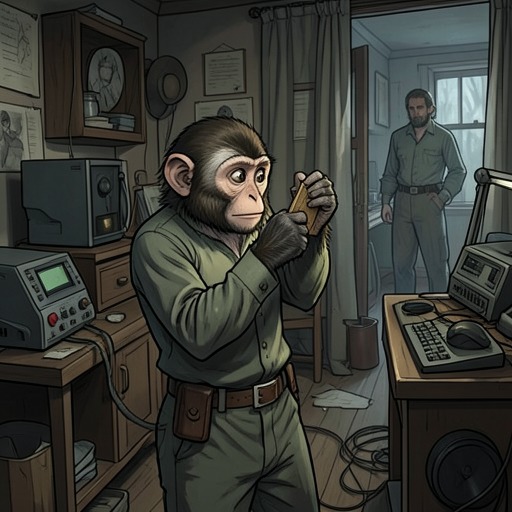
When the monkey’s account is met with a threat of violence, Mizuki intervenes. She says that what it is telling them is true, and that she has known the truth for a long time while trying to avoid it—closing her eyes and ears to what she did not want to face. Instead of letting the others beat the monkey, she asks that it be taken to the mountains and released. Her response turns the encounter: the revelation is painful, but she refuses to treat its speaker as guilty for exposing it.
Mizuki’s acceptance is not a claim that the discovery makes everything easy. She says she does not mind, provided she gets her name back, and resolves to live with what is out there. The movement is from avoidance to acknowledgment: a truth she had kept at a distance becomes something she is willing to face, while the name she feared losing becomes something she can claim again. Her resolution joins the two struggles without confusing them—the memory lapse is real, and so is the truth she had tried not to know.
After returning home, Mizuki puts the tag marked Mizuki Ozawa and the bracelet engraved Mizuki (Ozawa) Ando into a plain brown business envelope. She places the envelope inside a cardboard box in her closet. These objects had served as external safeguards and proof of identity; now, with her name restored, she stores them away rather than continuing to wear or consult them. She can resume a normal life, though the ending does not promise that circumstances will remain settled. Things might work out, or they might not. What matters to her is that she has her own name back, a name that is hers alone.